

Magento 1 : end of life but not end of the world
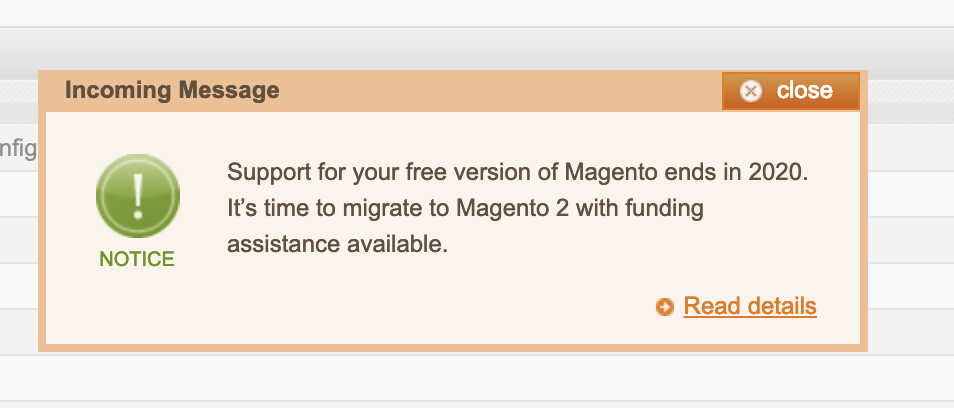
Happy user of Magento version 1.x, you have certainly been widely solicited by Magento pop-ups indicating that the end of life of Magento 1.x is approaching and that you should absolutely migrate to Magento 2.
Indeed, Magento “an Adobe company” will no longer support this version from the end of June 2020, but in reality, and this has been the case for a long time but in reality, and for a long time, it does not really support Magento 1.x since the rare patches brought in the last few years are provided, for the most part, by the community and very little by the editor itself. Magento mainly provides an official channel of distribution channel which will disappear from this date.
But,“Don’t Panic”it is not the end of the world and to make it simple, you can very well remain on this version (at least the Open Source version), it will obviously not stop working overnight. However, there will be the question of future security problems as well as PHP updates on your server.
We have had several requests from customers or prospects asking for our opinion, and for this reason, we decided to share it publicly. So in this article we will see what the current and real situation is, what the consequences are and what you can do about it.
Short history of Magento 2
Magento 2 has been available for a little more than 4 years and it is easy to understand that the editor wants to stop offering services around their old version 1.x. The abandonment has already been postponed several times, especially because of customers of the Enterprise version (now Magento Commerce) whose contracts are still running for some. Today, these customers are practically forced to either migrate to Magento 2 Commerce, or to choose another solution such as downgrading to the community version (today Magento Open Source) or to go to a completely different platform. This is not a job that can be done overnight, it requires preparation. The license does not allow them to continue to use the commercial version beyond this date and the merchant can be sued for breach of contract!
Four years is a long time for a software editor but for a merchant, it is barely the time to Therefore, pushing customers to migrate to Magento 2 may not be the priority for a customer.
Magento 2 projectstarted in 2010A migration from Magento 1 to Magento 2 means the launch of a brand new store, so it is a brand new project. The question is legitimate to say: “Do we continue with Magento or not? If we continue, do we stay on v.1.x or do we migrate to Magento 2 or to something else?”
Today, the current version is 2.3 and the release of version 2.4 is coming soon. This one is more stable than the previous versions. Magento has decided not to support versions lower than 2.3 as well on its extensions marketplace. For relatively recent projects, merchants should in theory upgrade their store to the latest major version fairly quickly. One might think that this should be easy, but the changes between versions are still quite important and require, depending on the complexity of the projects, several days or even weeks of work. And the longer you delay, the more time will be needed to complete it and therefore cost more. In practice, merchants are often reluctant to update, for various reasons: cost, numerous custom developments, other priorities, etc.
There is a debate in the community about the pace of updates because we could expect a LTS (Long Term Support) version to be longer than one year! We could also expect that the patches are not complete rewrites of features breaking the third party features. You have to take into account the inertia between the release of an update and its application in your store.
This problem of the pace of updates is not only for Magento, but for the whole Web industry. All the actors are under pressure concerning this race to update: PHP, the programming language behind Magento, has a fairly steady pace of updates as well, this affects all web applications using it. And the regular discoveries of security flaws don’t help matters. This is a topic that could be part of a whole separate article. Fortunately, about security updates, Magento finally offers for some time an alternative that does not necessarily require upgrading, so a realization, in principle, faster to implement.
Should I migrate to Magento 2?
There aremany discussionsregarding this issue in the Magento community. Magento and their partners have a vested interest in making you migrate, it is very lucrative for them. Many agencies or even Adobe play on the fear if you do not do it. It is necessary to nuance this state of affairs and take into account the reality of each person and ask yourself the following questions:
- What is the strategy of my company / my online store for the next 5 years?
- How much revenue do I get from my store? Is it enough to invest in new developments or a migration?
- What added value can I bring to my web clients? What tools do I need to achieve this?
- Is my customer segment always the right one, B2C rather than B2B (or the opposite)?
- What annual budget do I have for my store?
- Is the design and user experience of my site still up to date and adapted to the different uses that are made today?
- Have I made heavy investments in my store in recent years? Have they paid off?
- Is the current solution still adapted to my needs and sustainable?
- What do I gain or lose by migrating to another solution?
- How is the security of my store affected?
All these questions have an influence on your decision to take, we can accompany you for some of these points.
For some of our customers who are mostly SMEs, the migration to Magento 2 or other, requires reflection. Whatever happens, there is today a wide range of solutions to help you decide what to do.
What solutions?
Magento 1 still has a very large “love rib” among merchants, more than 150 000 online stores are still running on this version and according to some “twitter” polls, at least 39% of this number does not want to change, 61% are thinking of migrating to Magento 2. There are between 20 and 30 000 stores on Magento 2.
If we mix@gwilleminfo with this infohttps://t.co/IeeXFbqRuUwe may assume that 55K Magento 1.x shops (39%) will still run on the old version, 85K (61%) “may” move to M2 + 24K are in M2 (willem stats). 1/3 M1 - 2/3 M2 in possible future. Stats from onestep is only with 125 ppl
— Sylvain Rayé (@sylvainraye)September 23, 2018
This figure should be taken with care, but it gives an indication of the trend.
The eCommerce market and its solutions have evolved enormously in 10 years. There are many solutions and for owners of Magento version 1.x, you could consider the following solutions:
Magento 1.x LTS (Long Term Support) with OpenMage
OpenMageis an initiative of developers and agencies who want to continue to maintain Magento 1.x for their customers and share patches and improvements. This initiative is independent from Adobe and concerns only the Open Source version of Magento.
Available atthis address, Magento LTS from OpenMage is a very good alternative for those who want to stay on Magento 1. For our customers who wanted a recent update of their Magento, we have quickly implemented the OpenMage version that includes the current patches from Adobe but also from the developer community.
Pros : continuity in the use of Magento, low cost.
Cons : depends on the willingness to maintain this version or not because of the voluntary nature of this initiative, no clear roadmap.
MageOne
MageOneis another initiative of German developers who have formed a company to provide security updates for Magento 1.x and support for PHP upgrades that your hosting provider often pushes you to do. For a monthly subscription fee of a few euros depending on your turnover, MageOne offers to protect your store, at least the open source core of Magento. Your provider will install these updates.
We can make you an interesting offer if you want to continue for a while with your Magento 1.x and get patches from MageOne then migrate to other things in the future.
Pros : a company is behind this initiative and can bring you a multi-year warranty, reasonable price. MageOne provides patches through their platform.
Cons : all extensions and third-party developments require your provider to update them if the publishers of these extensions do not.
Front-Commerce
Front-Commerceis not an eCommerce platform in the sense that we traditionally know with Magento, it is a layer that is added to the front of your store and is responsible for presenting the data provided by a web application such as Magento or others and interacting with the visitor in an optimal and fast way. Front-Commerce is a PWA for progressive web application, a type of application strongly pushed by Google because it improves the user experience. A site created with Front-Commerce will be very fast in its navigation, only new data are loaded as needed, which will result in 1) increase your chances of better positioning in search engines 2) increase your sales.
Pros : allows you to modernize and optimize your store without having to change your CMS, a connector exists for Magento 1 and 2 (a connector for other solutions are under development), allows you to migrate from Magento 1 to Magento 2 in several steps in a smooth way if desired, the display of your site is managed by Front-Commerce but you continue to use your favorite CMS, can interface with Wordpress as well, increases the security of your store since your CMS (Magento in this case) is no longer directly exposed to the web.
Cons : the purchase of a license is mandatory.
Migrer vers Magento 2
Adobe provides a tool to migrate data from Magento 1 to 2 but everything related to design, features and third-party extensions require either finding equivalents for Magento 2 or developing them completely.
Pros : a still quite active community, many extensions available for marketing, content management, payment or delivery modes or other various functionalities, a powerful flexibility thanks to its API, many basic functionalities provided (this can also be a negative point because it makes the platform heavier), an integration with some Adobe tools (for example withAdobe Sensei).
Cons : a high TOC (total ownership cost), poor performance requiring complex tools to optimize the platform, a very good provider with deep knowledge of Magento 2 is required, a complex frontend, many bugs still present even if there have been major improvements since, unreliable support for licensees.
Sylius
SyliusSylius is an open source eCommerce framework that is still not well known to the public but is becoming increasingly popular with agencies and developers, with some great projects being released or in progress. Sylius offers tools to create an online store with the minimum necessary. The growing community offers more and more extensions. For example, we are working on a project to integrate Sylius with OroCRM.
Pros : a modern, stable, flexible and highly tested technology stack, a growing community that will probably be as big as Magento’s in the coming years, a Magento 1 to Sylius migration tool soon available, a reasonable TOC.
Cons : many features need to be developed, however, given the relative ease of doing so, development times are lower than for Magento 2, documentation not always up to date.
OroCommerce
OroCommerceis the B2B counterpart of Magento, already presented on our site, OroCommerce offers a long list of features adapted to the B2B world: management of multiple price lists based on many criteria, a powerful workflow engine allowing to adapt processes such as purchasing according to specific needs, advanced access rights management in both the front office and the back office, accelerated order placement, delegation of purchases, multi-tenant management and much more. Since version 4.1 LTS, OroCommerce offers tools that facilitate the implementation of a B2C site, allowing you to deactivate unwanted functionalities with a list of checkboxes, thus leaving you the possibility to offer both a complete B2B and B2C site.
Pros : very responsive support and attractive hosting for licensees, complete, stable and powerful B2B functionalities, direct support from Oro employees even for users of the Open Source version, multi-organization, multi-site management, a modern technological stack allowing to adapt according to needs, an integrated CRM with marketing automation tools.
Cons : not very adapted for small merchants because complex, low choice of third party extensions so a lot of specific developments needed (the advantage however is that you get a homogeneous platform because developed by the same provider), a provider with strong skills and experience with this platform is required, a high performance server infrastructure is needed.
Shopware
Shopwareis a B2C eCommerce platform of German origin with a similar approach to Magento and therefore a serious challenger to the latter. Shopware is open source and also has paid versions and a growing developer community. The new version of Shopware is the 6.x having a few months of existence, it seems however already quite stable. A migration tool from Magento 1.x to Shopware 6.x exists even if still incomplete, it allows to facilitate the migration work. The Shopware 5.x extensions are not compatible with the 6.x version but it is only a matter of time to see this number growing.
Pros : new modern and stable Shopware 6.x version offering a simple CMS page creation tool as standard, a more affordable TOC than Magento, an affordable license cost for the paid versions, a good alternative to Magento 1.x .
Cons : the documentation is mainly in German (the community of users and extension editors is small) even if this is changing, the third party extensions available for version 6.x are still few.
Conclusion
As you can see, there are a plethora of choices that vary depending on your needs, your business strategy and your and your budget, some solutions may be more suitable than others.
In many cases, if there is a migration, using a PIM like Akeneo can be a good idea. It gives you the opportunity to clean up your catalog and make your product information available for different channels or media (mobile, catalog, ecommerce, intranet, etc.) in a more simple and flexible way.
There are no wrong solutions but there can be wrong choices. We are happy to help you find the best option for your situation, with complete transparency. Do not hesitate to contact us.